About the planting guide
The planting guide tells you what to sow, what to plant out and what to start in trays this month, worked out for the spot where your garden is, not for a zone drawn across half a country. It is made by Milkwood.

What makes it different
Your own weather, thirty years of it
Most planting calendars split a country into a handful of climate zones, and a garden on a frosty hillside gets the same advice as one by the sea fifty kilometres away. This guide reads thirty years of daily weather, from 1994 to 2023, for the 9 km square your garden is in: every overnight low, every daytime high and every day's rain.


Corrected for your height
Air cools by about 6.5 °C for every kilometre you climb, so a garden up a hill is colder than the valley below it. The guide finds your garden's height from a satellite map of the earth's surface, or uses the height you give it, and moves the temperatures to suit.
Weather stations, where they exist
In Australia and North America the overnight lows, daytime highs and rain come from daily weather maps built from weather station records: SILO from the Queensland Government, and Daymet from NASA and Oak Ridge National Laboratory. Elsewhere they come from ERA5-Land, a reconstruction of past weather for every patch of land on earth. We checked the Australian figures against 219 weather stations over the same thirty years: average overnight lows for each month came within about half a degree.
Your own frost dates
Frost decides more of the planting year than anything else. The guide works out when your last spring frost and first autumn frost usually fall, how late or early they can come in a bad year, and how many frost-free days you usually get. If you know your garden better than any map, you can enter your own frost dates and height on your account page, and the guide uses them instead.
What each vegetable needs
For more than a hundred vegetables and herbs, the guide knows the temperatures each one grows in, how much frost it can take, how warm the soil must be for its seed to come up, and how long it needs before the weather turns. A month your climate cannot support is ruled out, whatever any other source says.


Planting guides from places with a climate like yours
On top of that, the guide reads published planting guides that we are allowed to use: openly licensed ones, such as the Western Australian agriculture department's guide for home gardeners; old ones now out of copyright, from Australian agriculture departments, journals and books going back to the 1890s; and copyrighted guides whose publishers have given us permission. A guide only counts at your garden if the place it was written for has a climate close to yours, and the closer the match the more it counts.
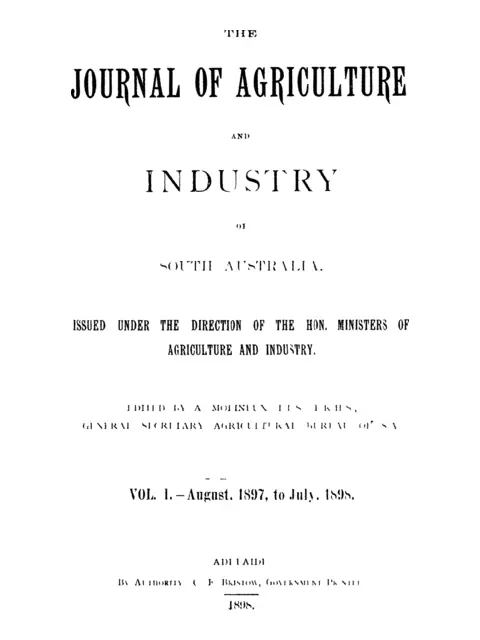 Quinn 1897–1900
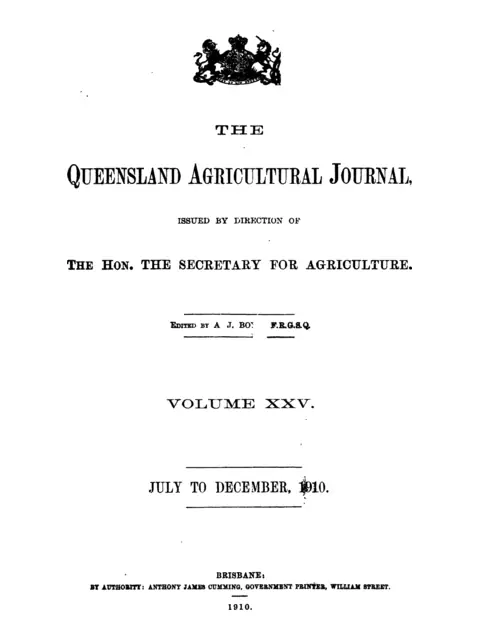 Qld Agricultural Journal 1910–16
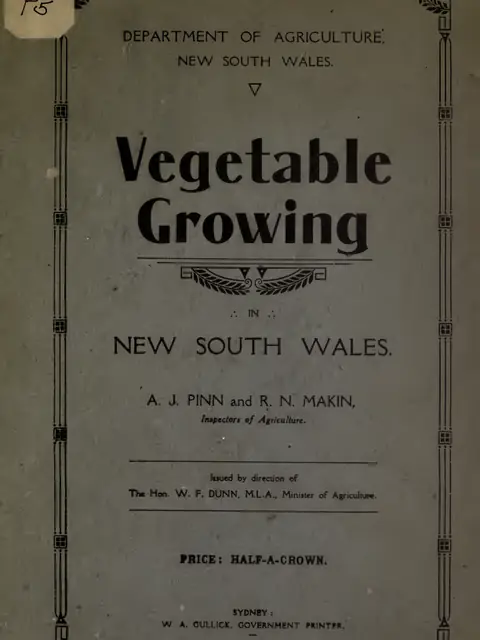 Pinn & Makin 1920
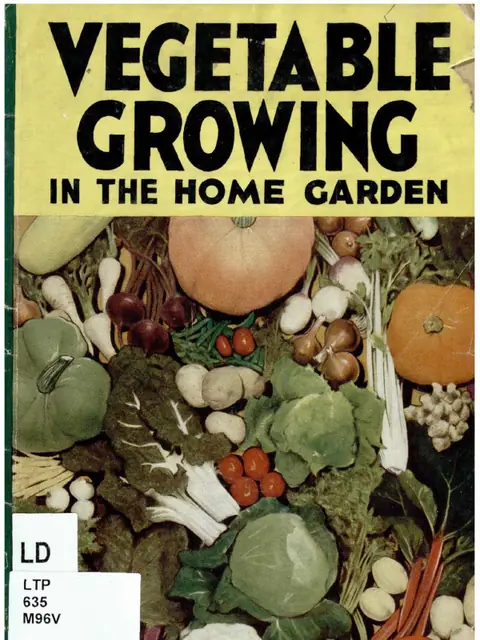 Murray & Bennett 1942
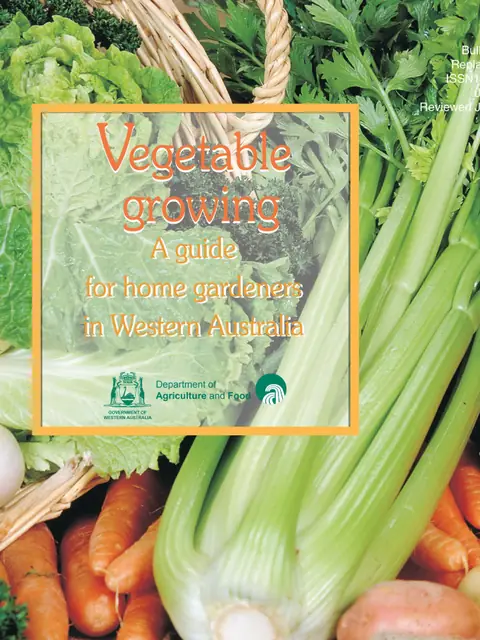 WA DPIRD 2009
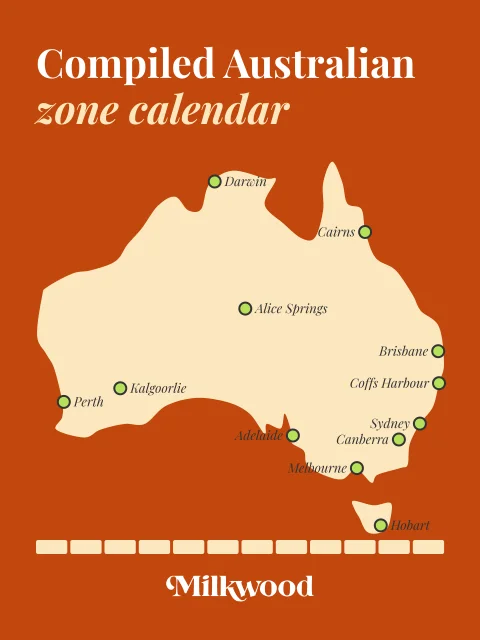 Milkwood 2026
Both hemispheres
Seasons run six months apart either side of the equator, so the guide turns a guide's calendar around when it is written for the other half of the world. It also compares how much the length of the day changes through the year, because onions bulb, potatoes form tubers and brassicas run to seed partly in answer to the length of the day.
A seed-tray window, as a northern guide prints it
The same window, read for a southern garden
What it cannot tell you
- It works on temperature and frost, not on humidity or a wet season. In the wet tropics it can suggest a plant, such as rosemary, that would rot in the wet. Local knowledge wins there.
- It knows your climate, not this year's weather. Its frost dates are what usually happens; a late frost can still come, so keep an eye on the forecast before planting out tender seedlings.
- It cannot see your garden. A 9 km square does not know about your frost hollow, your sheltered north wall or the wind off the hill. On a cold valley floor frost can come later in spring than the guide shows.
If something looks wrong for your garden, please tell us: from any page.
Who we are

Milkwood is dedicated to teaching and sharing permaculture skills, for living like it matters. We teach permaculture living, organic veggie gardening and home mushroom cultivation, to help create resilient and abundant households and communities.
It began in 2007 on a farm in New South Wales, where Kirsten Bradley and Nick Ritar had moved the year before to build a tiny house and grow some food. Milkwood is now based in talune / Cygnet, in southern lutruwita / Tasmania, on Melukerdee country, and teaches through online courses. Nick is Milkwood's managing director and Kirsten its creative director; both write the courses and teach.
The planting guide was made for students of Milkwood's Organic Vegetable Gardening course, and for now it is open to them. Read more about Milkwood, or see all our courses.
Credits
Contains modified Copernicus Climate Change Service information 2026. Neither the European Commission nor ECMWF is responsible for any use that may be made of the Copernicus information or data it contains.
Weather data by Open-Meteo.com (CC BY 4.0), averaged by month and adjusted for height.
Contains SILO data, Queensland Government (CC BY 4.0), averaged by month and adjusted for height.
Thornton, M. M., Shrestha, R., Wei, Y., Thornton, P. E., & Kao, S.-C. (2022). Daymet: Daily Surface Weather Data on a 1-km Grid for North America, Version 4 R1 (Version 4.1). ORNL Distributed Active Archive Center. doi:10.3334/ORNLDAAC/2129
Heights from the Copernicus DEM GLO-90, © DLR e.V. 2010–2014 and © Airbus Defence and Space GmbH 2014–2018, provided under COPERNICUS by the European Union and ESA; all rights reserved.
Place names from GeoNames (CC BY 4.0).
Lino prints by Dalee Ella, commissioned by Milkwood for the Organic Vegetable Gardening course.
Photos by Natalie Mendham, Nick Ritar and Breeana Dunbar for Milkwood.
Cover of Notes on vegetable-growing, Journal of Agriculture and Industry of South Australia (1897–1900): Public domain. Scan: Digital Library of India, via the Internet Archive.
Cover of Queensland Agricultural Journal: farm and garden notes (1910–16): Public domain. Scan: Digital Library of India, via the Internet Archive.
Cover of Vegetable growing in New South Wales (1920): Public domain. Scan: University of California Libraries, via the Internet Archive.
Cover of Vegetable growing in the home garden (1942): Out of copyright (State Library Victoria).
Cover of Vegetable growing: a guide for home gardeners in Western Australia (2009): Cover © State of Western Australia (DPIRD), CC BY 4.0.
Cover of Milkwood – Compiled Australian zone calendar (2026): our own.